Outdoor Lighting in Bryan and College Station Landscapes
How Strategic Lighting Extends Your Yard Past 8pm
Greener Lawnscapes • July 2026 • Bryan/College Station, TX
In Bryan and College Station, the most useful months for being outside are also the months when the sun is brutal until 8 or 8:30 in the evening. Strategic outdoor lighting turns a yard that is unusable until late into a yard that hosts dinner at 9. A typical Brazos Valley front-and-back lighting installation runs about $3,500 to $9,500 in fixtures and labor.
Why Lighting Matters More in Texas Than in Cooler Climates
By early July in Bryan and College Station, the practical outdoor window runs from about 8 in the evening until 11 or midnight. The middle of the day is too hot. The actual usable outdoor entertaining window in the hottest months is after the sun drops behind the trees.
Without Lighting
Outdoor season runs effectively from mid October through mid May — limiting useful yard time to cooler months only.
With Lighting
Outdoor season runs year-round. That is a difference of about five months of practical outdoor use per year — and what justifies the investment.
The Three Layers of a Great Lighting Design
Layer 1: Path & Step Lighting
The safety and orientation layer. Marks where to walk, where steps change elevation, and where patio meets lawn. One fixture per 8–10 feet of pathway, staggered — never lined up symmetrically. Typical output: 2–4 watts LED per fixture.
Layer 2: Accent Lighting
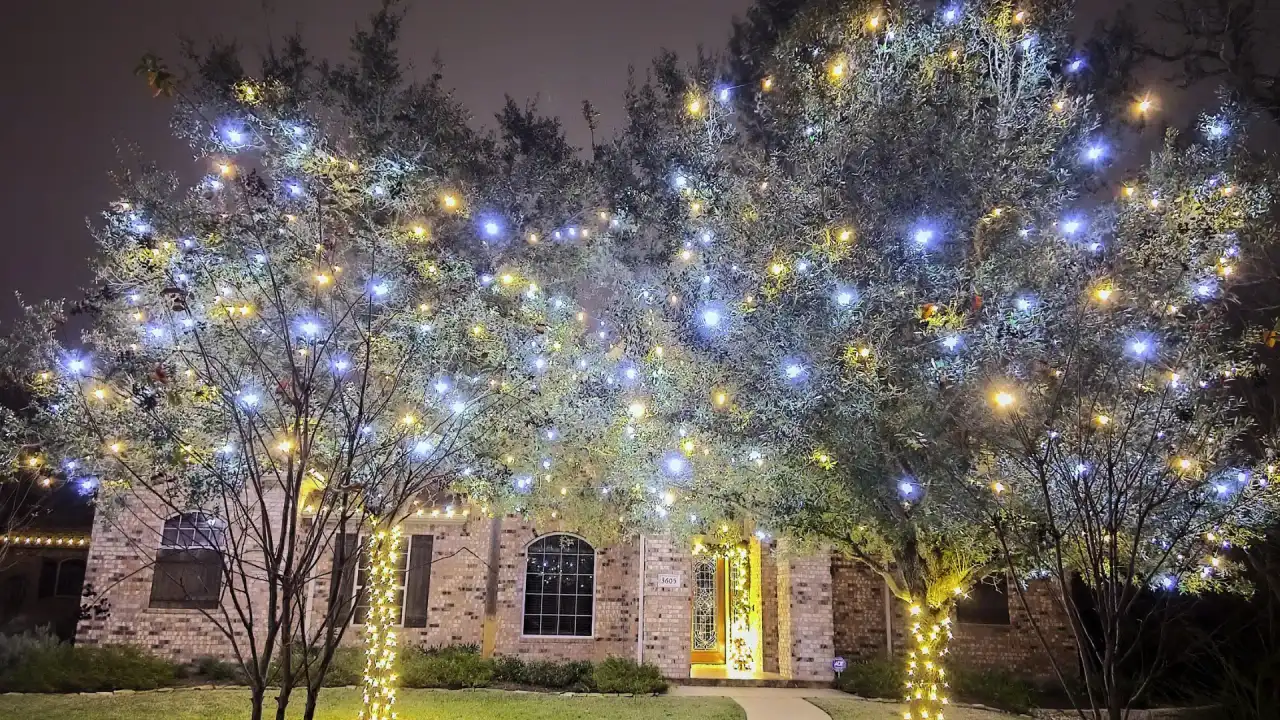
The layer that turns a yard into a designed space at night. Uplighting dramatizes trunk and canopy; moonlighting from high in the tree casts dappled light below. A typical property has 4–8 trees worth lighting plus 2–4 shrub groupings.
Layer 3: Architectural Lighting
Lights the house and major built features — fireplaces, pergolas, stone walls. Gives the property a sense of presence at night. All fixtures at 2700–3000 Kelvin warm white. Never cooler than 3000 K.
Layer-by-Layer Installed Costs
Path & Step Layer
$110–$180 per fixture installed. Typical front walkway and side path: 8–14 fixtures.
$900–$2,500
Accent & Tree Layer
$175–$260 per uplight, $220–$320 per downlight. 4–8 trees plus shrub groupings.
$1,400–$3,800
Architectural Layer
$180–$280 per fixture. Typical house front needs 4–8 fixtures to read well at night.
$800–$2,200
Transformer & Controls
Quality LED transformer, wiring, and controller package including smart Wi-Fi option.
$700–$1,200
Full Project Cost: What to Expect
Front-Only or Patio-Only
$2,500–$4,000
Smaller scoped projects targeting one area of the property.
Typical Half-Acre Front & Back
$4,700–$9,900
All three layers, quality transformer, and smart controls for a standard Brazos Valley property.
Large or Heavily Landscaped
$12,000–$25,000
Multiple seating areas, pool surrounds, extensive tree canopy, and complex hardscape.
The single biggest cost variable is fixture count rather than fixture quality. What separates a great design from a mediocre one is placement, aim, and what is intentionally left in shadow.
What to Specify: LED, Voltage, and Materials
Low-Voltage LED Systems
12–15 volt systems with 30,000–50,000 hour lamp life (12–15 years of nightly use). Fraction of the wattage of older halogen systems and safe to work near.
Brass & Copper Fixtures
Solid brass or copper handles Brazos Valley summer humidity well and develops a patina over time. Aluminum and painted fixtures degrade. We use brass or copper on virtually every install.
2700–3000 Kelvin Only
Warm white LEDs that read like an old incandescent outdoors. We do not install anything cooler than 3000 K. Cooler temperatures read as harsh and institutional.
Properly Sized Transformers
Sized for the load with 20% overhead. An undersized transformer runs hot, drops voltage, and shortens lamp life. We document every wire run for future service.
Controls and Scheduling
Astronomic Timer
Turns lights on at dusk and off at a homeowner-selected time — usually 11pm or midnight. Reliable, straightforward, and included in every install.
Wi-Fi Smart Controller
Adds app control and the ability to set scenes — patio party, security, holiday. Costs $200–$400 more at install. Most homeowners who choose it use it regularly.
The Three Mistakes We See Most Often
Mistake 1: Over-Lighting
More lights do not mean a better result. Past a certain point, more fixtures flatten the design. Shadow is part of how outdoor lighting reads. A yard uniformly bright at night looks like a parking lot. We aim for contrast: lit features against dark backgrounds.
Mistake 2: Cool Color Temperature
Big-box LED fixtures often default to 4000 K or higher. The light reads as harsh and institutional outdoors. The fix is to specify 2700–3000 K from the start.
Mistake 3: Poor Aiming
A perfectly placed fixture aimed wrong produces glare instead of illumination. We aim every fixture at night during commissioning. Aiming in daylight does not work — the right result is only visible in the dark.
Frequently Asked Questions
How long does installation take?
A typical residential project takes 2–4 days. Day one is layout and trenching, day two is fixture installation and wiring, day three is night-time aiming and commissioning. Larger projects take a week.
Will lights survive Brazos Valley storms?
Quality brass and copper fixtures with sealed connections handle storms well. Wire is buried below typical disturbance depth. Tree fixtures are mounted with appropriate strain relief. Severe storm damage is uncommon.
What does annual maintenance cost?
We recommend an annual service visit covering lamp checks, fixture cleaning, re-aiming, transformer inspection, and connection check. Cost runs $200–$350 per year and adds significantly to design lifespan.
Can I add lighting to existing landscape later?
Yes. Low-voltage systems are easy to extend if the original transformer has capacity. We often phase larger projects across two budget cycles to spread cost.
Ready to Use Your Yard After Dark?
We will walk your yard at dusk, tell you which features are worth lighting, which to leave alone, and what realistic phasing looks like if you want to spread the project across two seasons. Lighting is designed as part of the broader landscape — not tacked on as an afterthought.